
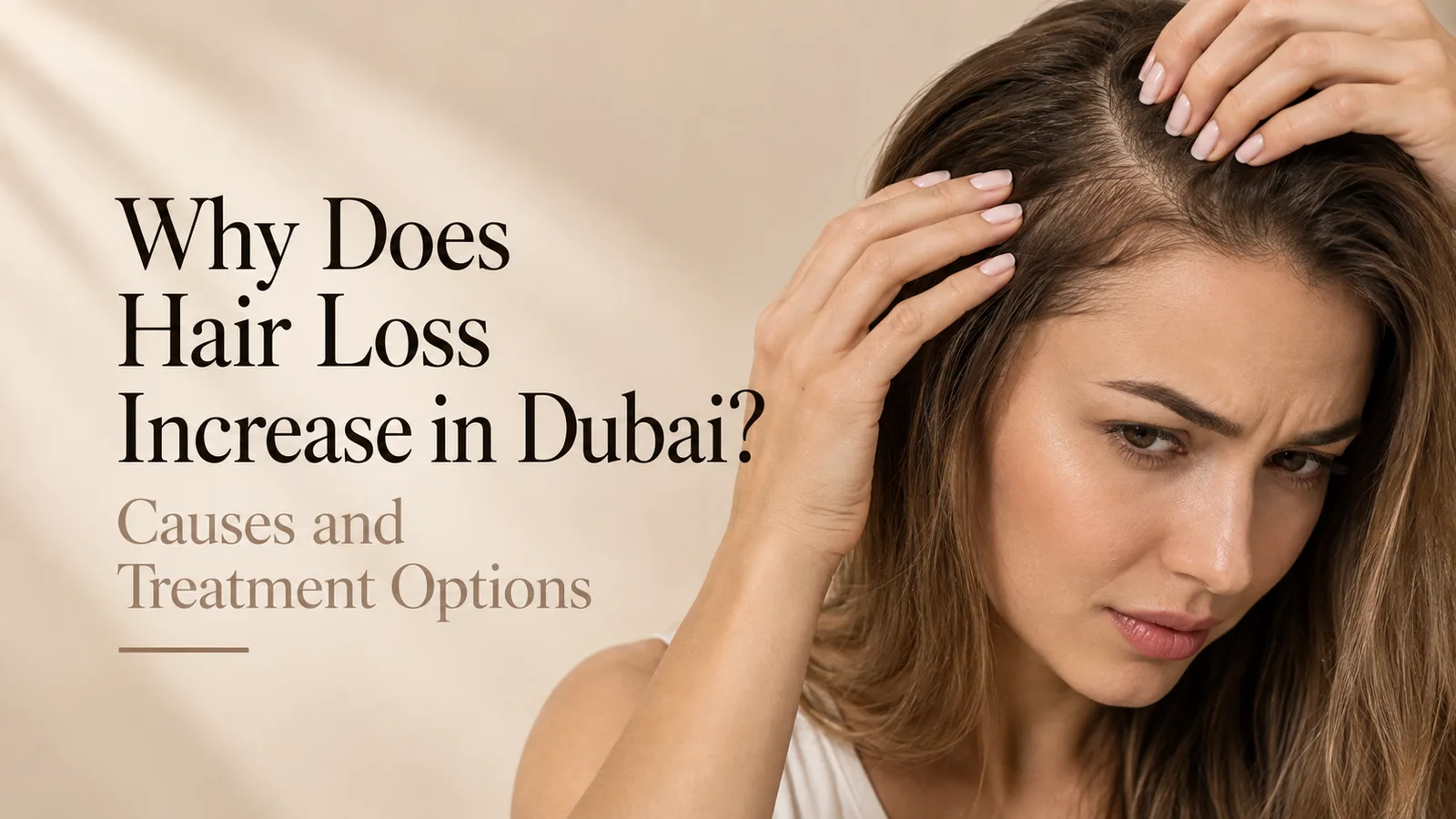
Moving to Dubai — or simply living here for several years — can sometimes coincide with a noticeable change in your hair.
More hair in the shower. A wider parting. Reduced density around the temples. A ponytail that suddenly feels thinner.
And one of the first explanations patients often hear is:
“It’s the Dubai water.”
But hair loss is rarely that simple.
Excessive shedding can be related to stress, hormonal changes, nutritional deficiencies, thyroid disorders, rapid weight loss, pregnancy, illness, genetic predisposition, scalp conditions and other medical factors.
The environment may affect the condition and appearance of the hair shaft, but true hair loss should be approached as a medical concern that requires identifying the underlying cause.
Hair Shedding vs Hair Loss: What’s the Difference?
Before starting treatment, it is important to understand what is actually happening.
Hair naturally moves through several stages of a growth cycle. At any given time, some hairs are actively growing while others are resting and eventually shedding.
A certain amount of daily hair shedding is therefore normal.
The problem begins when shedding becomes significantly more noticeable, hair density gradually decreases, the central part becomes wider, the temples begin to thin, the scalp becomes more visible, individual hairs become progressively finer or clearly defined patches develop.
Different patterns can indicate completely different types of hair loss.
That distinction matters because there is no universal “hair loss treatment” that works for every patient.
Why Can Hair Loss Seem Worse After Moving to Dubai?
There is no single medical condition called “Dubai hair loss.”
Instead, several factors associated with lifestyle changes, environment and general health can occur at the same time.
Stress and Lifestyle Changes
Moving country, changing jobs, disrupted sleep, emotional stress and major lifestyle changes can all affect the body.
One of the most common forms of diffuse hair shedding is telogen effluvium.
It occurs when a larger-than-normal proportion of hair follicles prematurely enter the resting phase of the hair cycle.
The shedding often becomes noticeable weeks or months after the original trigger, which means patients do not always connect the two events.
Potential triggers include significant emotional stress, acute illness, high fever, surgery, rapid weight loss, restrictive dieting, major lifestyle changes, certain medications, hormonal changes, postpartum changes and nutritional deficiencies.
This is why simply treating the scalp without investigating the patient's recent medical and lifestyle history may miss the actual cause.
Iron and Nutritional Deficiencies
Hair follicles are metabolically active structures and can be affected by nutritional status.
Depending on the individual patient, deficiencies or imbalances involving iron, vitamin D, zinc and other micronutrients may be relevant.
However, this does not mean that every patient experiencing hair loss should immediately start taking multiple supplements.
Excessive supplementation is not a substitute for diagnosis.
Blood tests should be selected according to the patient's history, symptoms, diet and suspected type of hair loss.
If a clinically relevant deficiency is identified, correcting it may become an important part of the treatment programme.
Vitamin D
Living in a sunny country does not automatically mean that vitamin D levels are optimal.
People living in very hot climates may spend substantial amounts of time indoors and intentionally avoid direct sun exposure.
Vitamin D deficiency has been reported in association with several types of non-scarring alopecia.
However, vitamin D should not be treated as a universal cure for hair loss.
If deficiency is suspected, the appropriate approach is to measure the level and correct a confirmed deficiency when medically indicated.
Thyroid and Hormonal Factors
Hair changes can sometimes be a visible sign of an internal medical issue.
Both hypothyroidism and hyperthyroidism can be associated with diffuse hair changes or shedding.
Hormonal factors can also influence hair growth in patients with androgenetic alopecia.
This is particularly important when hair loss occurs together with other symptoms or changes.
A medical assessment may therefore include investigation of thyroid or hormonal factors when clinically appropriate.
Postpartum Hair Loss
Many women experience significant shedding several months after giving birth.
During pregnancy, hormonal changes can keep more hairs in the growth phase.
After delivery, the hormonal environment changes and a larger number of follicles may enter the resting phase.
The result can be dramatic diffuse shedding.
Although postpartum telogen effluvium often improves over time, pregnancy and postpartum changes can also reveal an underlying predisposition to female pattern hair loss.
If density does not recover as expected, further assessment may be necessary.
Rapid Weight Loss and Restrictive Dieting
Significant calorie restriction, inadequate protein intake or rapid weight loss can act as physiological stressors and may trigger telogen effluvium.
Hair loss may not begin immediately.
Because of the hair-growth cycle, patients may notice increased shedding several months after the period of weight loss.
This timing is important when taking a medical history.
Is Dubai Water Really Causing Your Hair Loss?
This is one of the most common questions.
The relationship between water hardness and hair is often oversimplified.
Mineral-rich water may affect the hair shaft, potentially contributing to deposits, changes in feel, dryness or breakage in some circumstances.
But breakage is not the same as hair loss from the follicle.
If your hair is becoming progressively thinner at the roots, your parting is widening or overall density is decreasing, blaming the water alone may delay identification of the real cause.
A shower filter may change how the hair feels, but it should not be considered a medical treatment for true alopecia.
The more important question is whether the hair is breaking — or whether fewer hairs are actually growing from the scalp.
Dubai Climate Can Affect the Hair — But Not Always in the Way You Think
Heat, air conditioning, frequent swimming, UV exposure and repeated washing can all influence how the hair looks and feels.
Hair may become drier, rougher or more prone to breakage.
Patients can understandably interpret this as “hair loss”.
But the distinction between hair-shaft damage and follicular hair loss is important.
If hairs are breaking along their length, the strategy may involve hair care and reducing external damage.
If hair density is genuinely decreasing from the scalp, a medical assessment is more important.
The two problems can also occur simultaneously.
Female Pattern Hair Loss Can Be Easy to Miss
Not all hair loss presents as dramatic shedding.
Female pattern hair loss may develop gradually.
A patient may notice that her ponytail has become smaller, the central part looks wider in photographs or the scalp is increasingly visible under bright light.
Individual hairs may also become progressively finer through a process known as miniaturisation.
Because this happens slowly, patients sometimes assume that stress, water or hair colouring is responsible.
Unlike a temporary episode of telogen effluvium, androgenetic hair loss can be progressive.
Recognising the pattern early can therefore be important when planning treatment.
What About Hair Loss in Men?
In men, androgenetic alopecia commonly affects the frontal hairline, temples and crown.
Genetic predisposition and androgen sensitivity play an important role.
Men may also develop telogen effluvium, nutritional deficiencies, scalp disease or other forms of hair loss, so not every case of male thinning should automatically be assumed to be genetic.
A sudden change in shedding pattern or development of clearly defined patches should be assessed rather than simply treated cosmetically.
Scalp Health Matters Too
Sometimes the problem is not only the hair follicle.
Inflammatory or dermatological scalp conditions can affect scalp comfort and may coexist with increased shedding.
Symptoms such as persistent itching, scaling, redness, pain, burning or significant dandruff deserve attention.
Treating hair loss while ignoring active scalp disease can limit the effectiveness of the overall plan.
When Should You Investigate Hair Loss?
An occasional increase in shedding does not necessarily indicate disease.
But assessment becomes particularly important when hair loss is persistent, rapidly worsening or accompanied by a visible reduction in density.
You should also consider medical evaluation if you notice a widening part, progressive temple thinning, bald patches, scalp symptoms, significant hair miniaturisation or hair loss following a major medical or hormonal change.
The history often gives important clues.
When did the shedding begin?
What happened two or three months before it started?
Was there illness, surgery, childbirth, rapid weight loss, significant stress or a medication change?
Has the hair become thinner gradually over several years?
These questions can be more informative than immediately choosing a hair procedure.
Do You Need Blood Tests for Hair Loss?
Sometimes — but not every patient requires the same panel of tests.
Investigations should be selected according to the clinical history and suspected diagnosis.
Depending on the patient, a doctor may consider evaluating factors such as iron status, thyroid function, vitamin D or other nutritional and hormonal parameters.
The important principle is targeted investigation.
Ordering every possible test without a clinical reason is not necessarily better medicine, just as taking supplements “for hair” without identifying a deficiency is not necessarily useful.
What Treatments Can Help Hair Loss?
This depends entirely on the diagnosis.
There is no single treatment that should be offered to every patient who notices increased shedding.
For some patients, the most important intervention is correcting an underlying deficiency or medical trigger.
For others, medical treatment for pattern hair loss may be appropriate.
Scalp disease needs to be treated as scalp disease.
And selected patients may benefit from regenerative or procedural treatments as part of a broader plan.
At Pearl Skin Polyclinic, treatment may include options such as PRP therapy, injectable scalp protocols and other personalised hair-restoration strategies when clinically appropriate.
The procedure should support the diagnosis — not replace it.
Where Does PRP Fit Into Hair-Loss Treatment?
PRP, or platelet-rich plasma, is prepared from a sample of the patient's own blood.
The blood is processed to obtain a platelet-rich plasma fraction, which is then administered into selected areas of the scalp.
PRP may be incorporated into treatment programmes for selected patients with hair thinning or reduced density.
But PRP is not a universal solution.
If a patient is shedding because of an untreated thyroid disorder, severe nutritional deficiency or another underlying medical trigger, injections alone do not address the cause.
Likewise, different forms and stages of hair loss may respond differently.
PRP makes the most sense when it has a defined role within a properly diagnosed hair-loss programme.
What About Hair Mesotherapy and Injectable Scalp Treatments?
Injectable scalp treatments are another category patients frequently ask about.
Depending on the patient's condition, selected injectable protocols may be used to support scalp and hair quality.
However, the same rule applies.
An injection should not become the diagnosis.
Before deciding whether PRP, mesotherapy or another regenerative treatment is appropriate, we need to understand why the patient is losing hair in the first place.
Can Lost Hair Grow Back?
Sometimes.
The answer depends on the cause and the condition of the follicles.
Hair shedding caused by a temporary trigger such as telogen effluvium may improve once the trigger resolves and the normal hair cycle recovers.
Other forms of hair loss may be progressive and require ongoing management.
Long-standing follicular miniaturisation or scarring alopecia represents a very different situation.
This is why early assessment can matter.
The word “hair loss” describes a symptom. It does not tell us whether the process is temporary, progressive or potentially irreversible.
Why Buying “Hair Vitamins” Is Not Always the Answer
When shedding starts, many patients immediately buy biotin, iron, zinc or multivitamin products.
But more is not always better.
A supplement can be useful when it corrects a clinically relevant deficiency.
Taking nutrients without knowing whether they are deficient may be unnecessary, and excessive intake of certain supplements can create its own problems.
Hair treatment should not become a collection of random products.
Identify the problem first. Treat what is actually present.
So, Is Dubai Making Your Hair Fall Out?
Dubai itself is rarely the complete explanation.
Living here may coincide with several factors that influence hair and scalp health: a major lifestyle transition, stress, indoor living, dietary changes, weight loss, pregnancy, climate exposure or changes in hair care.
Hard water may affect the feel or condition of the hair shaft, but progressive thinning from the follicle deserves a broader medical assessment.
If you notice significantly increased shedding or reduced density, the useful question is not simply:
“What shampoo should I use?”
It is:
“Why has my hair cycle changed?”
Hair Loss Treatment in Dubai: Start With the Cause
At Pearl Skin Polyclinic in Dubai, hair-loss assessment begins with the pattern and history of the problem.
We consider when the shedding started, whether density is changing, scalp condition, recent illness or stress, pregnancy and postpartum changes, weight loss, nutritional factors, medications, hormonal factors and family history.
Further investigation may be recommended when clinically appropriate.
Only after identifying the likely cause do we decide whether the treatment plan should involve medical management, correction of underlying factors, PRP, injectable scalp treatments or another approach.
Because when it comes to hair loss, the most important treatment is not necessarily the newest procedure.
It is the treatment that matches the reason the hair is being lost.