

Laser Hair Removal with Cutera excel® HR in Dubai
Two wavelengths, one platform, for a wide range of skin types.
At Pearl Skin Polyclinic, laser hair removal is performed using excel® HR by Cutera, a professional dual-wavelength laser platform combining a high-powered 755 nm Alexandrite laser with a long-pulse 1064 nm Nd:YAG laser.
- Cutera excel® HR platform
- 755 nm and 1064 nm
- Built-in contact cooling
- Skin types I to VI
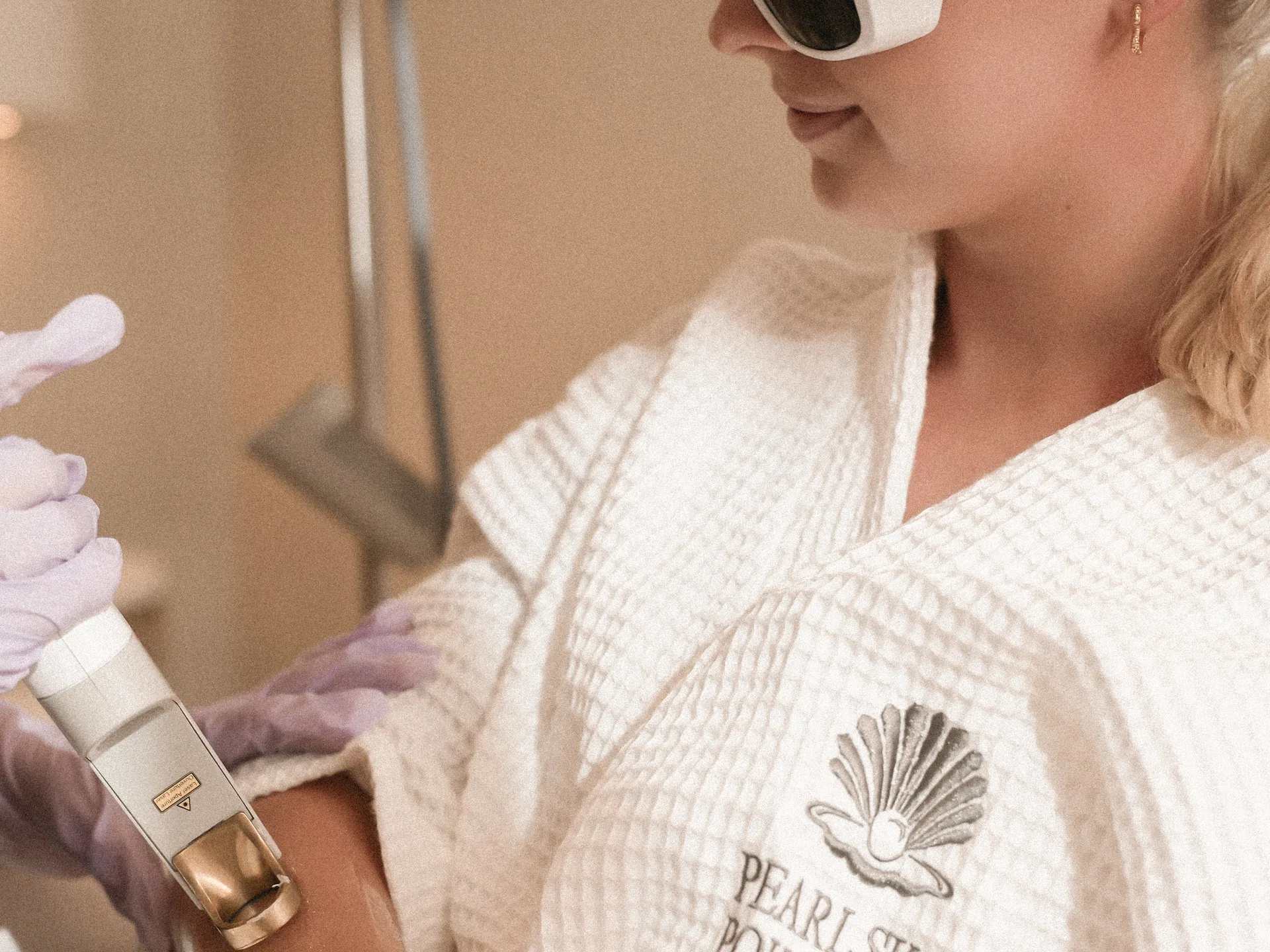
What Can Laser Hair Removal Help With?
- UNWANTED HAIRProgressive reduction of unwanted terminal hair on appropriate facial and body areas.
- INGROWN HAIRSReducing hair growth may help patients who repeatedly develop ingrown hairs after shaving, waxing or other temporary hair-removal methods.
- PSEUDOFOLLICULITIS BARBAEThe 1064 nm wavelength of excel® HR is also indicated for treatment of pseudofolliculitis barbae — inflammatory bumps associated with ingrown hairs, particularly in beard areas.
- STRAWBERRY SKIN APPEARANCEVisible follicular dots can have several causes. When the appearance is strongly associated with visible hair follicles, shaving and recurrent irritation, laser hair reduction may improve the overall appearance. However, keratosis pilaris and other follicular conditions are separate problems and should be diagnosed correctly.
- SHAVING-RELATED IRRITATIONPatients who repeatedly experience irritation from shaving may benefit from reducing the amount and density of hair that requires mechanical removal.
- POST-INFLAMMATORY PIGMENTATION AFTER INGROWN HAIRSRecurrent ingrown hairs and inflammation can leave dark marks. Laser hair reduction can help address the trigger — recurrent hair-related inflammation — while established pigmentation may require its own treatment strategy.
About this treatment
- Platform
- excel® HR by Cutera
- Wavelengths
- 755 nm Alexandrite and 1064 nm Nd:YAG wavelengths
- Areas
- Face • Bikini • Underarms • Legs • Arms • Back • Full Body
- Sessions
- no universal number of sessions suitable for every patient
How Does Laser Hair Removal Work?
Laser → Hair Melanin → Controlled Heat → Follicular Target → Progressive Hair Reduction
Why Two Wavelengths?
755 nm Alexandrite
- Ideal for lighter skin types and fine to medium hair. Targets melanin effectively.
1064 nm Nd:YAG
- Deeper penetration, safely treats darker skin types and coarser hair.
The combination allows us to personalize treatment for a wide range of skin types (I–VI).
Treatment Areas
FULL BODY
Full Body Laser Hair Removal in Dubai A personalised full-body protocol can be created according to the areas requiring treatment, skin phototype and hair characteristics.
Cheeks — Where Appropriate • Full Face — After Individual Assessment
Why Choose Cutera excel HR?
- Dual wavelength (755 nm Alexandrite + 1064 nm Nd:YAG)
- Effective on a wide range of skin types (I–VI)
- High speed and large spot sizes for quicker treatments
- Contact cooling for comfort and skin protection
- Clinically proven technology and safety
- Long-term hair reduction with a series of treatments
Precise and controlled treatments
Suitable for most skin types and areas
Minimal downtime
Safe, effective and clinically proven
Consultation Before Treatment
is essential to assess your skin type, hair type and medical history.
A personalized treatment plan is created for the best and safest results.
- Treatment time15–60 minutes (Depends on area)
- DowntimeMinimal to none
- ComfortBuilt-in contact cooling for comfort
- Number of sessions6–8 sessions on average (Depends on individual)
- Safe for skin typesI – VI
- Best resultsOn dark hair
Possible Side Effects & Risks
Temporary reactions may include: Redness • Perifollicular Swelling • Warmth • Tenderness • Temporary Skin Sensitivity
Other adverse effects are possible, including pigmentary changes, blistering or burns.
Risk is influenced by:
Skin Phototype • Recent Sun Exposure • Treatment Parameters • Treatment Area • Hair Characteristics • Individual Response
Appropriate wavelength selection, parameter selection and patient assessment are therefore important.
Read more about laser hair removal
How Does Laser Hair Removal Work?
1 — LASER ENERGY The selected wavelength delivers controlled laser energy into the skin.
2 — MELANIN IN THE HAIR ABSORBS ENERGY Pigment within suitable hair absorbs the laser energy.
3 — ENERGY IS CONVERTED INTO HEAT The absorbed light energy is converted into thermal energy.
4 — HEAT AFFECTS THE HAIR FOLLICLE Controlled heat is transferred to structures involved in hair production.
5 — PROGRESSIVE HAIR REDUCTION Following repeated treatments targeting hairs during appropriate stages of the growth cycle, the number and density of hairs can progressively decrease.
At Pearl Skin Polyclinic, laser hair removal is performed using excel® HR by Cutera, a professional dual-wavelength laser platform combining a high-powered 755 nm Alexandrite laser with a long-pulse 1064 nm Nd:YAG laser.
Having two wavelengths allows treatment to be adapted according to skin phototype, hair characteristics and treatment area rather than using the same laser parameters for every patient.
The system also incorporates sapphire contact cooling, designed to continuously cool the epidermis and improve comfort during laser treatment.
The goal is progressive, long-term hair reduction using a wavelength and treatment strategy selected for your skin and hair.
What Is excel® HR by Cutera?
excel® HR is a professional laser platform developed by Cutera for hair removal and other selected aesthetic indications.
Its defining feature for hair removal is its dual-wavelength system: 755 nm Alexandrite and 1064 nm Nd:YAG
The two wavelengths have different optical characteristics and interact differently with melanin and surrounding tissue.
This gives the clinician greater flexibility when treating patients with different skin phototypes and hair characteristics.
The platform also incorporates Cutera's sapphire contact cooling, which cools the skin before, during and after delivery of laser pulses.
Why Are Several Laser Hair Removal Sessions Necessary?
Hair does not grow continuously at the same stage.
Individual follicles move through different phases of the hair-growth cycle.
Laser hair removal is most effective when suitable hairs are in a growth phase in which the follicular structures can be effectively targeted.
At any single appointment, not every hair in the treatment area is at the same stage.
This is why laser hair removal is performed as a course rather than a single treatment.
The treatment interval may also differ according to the area.
Facial hair and leg hair, for example, do not necessarily follow identical growth patterns.
Why Does Hair Colour Matter?
Laser hair removal relies significantly on melanin within the hair as a target.
Dark, pigmented terminal hair generally provides a stronger optical target than hair containing very little melanin.
Very light blonde, white or grey hair may respond poorly because there may not be enough pigment within the hair to efficiently absorb the laser energy.
This is why consultation should include an assessment of both skin colour and hair colour, not skin phototype alone.
Why Two Wavelengths?
- 755 nm AlexandriteThe 755 nm Alexandrite wavelength is strongly absorbed by melanin. It is particularly useful when the patient's skin and hair characteristics make Alexandrite an appropriate choice, including selected finer hair in lighter skin phototypes.
- 1064 nm Nd:YAGThe 1064 nm Nd:YAG wavelength penetrates more deeply and has a different relationship with epidermal melanin. This makes it an important option for hair removal across a broader range of skin phototypes, including darker skin.
Why Does This Matter?
A patient with fair skin and dark hair should not automatically receive the same laser settings or wavelength strategy as a patient with darker skin.
Skin phototype, recent sun exposure, hair colour, hair thickness and anatomical area all influence treatment planning.
The availability of both 755 nm Alexandrite and 1064 nm Nd:YAG wavelengths allows the treatment strategy to be adapted according to the individual patient.
The goal is not to choose one “best laser” for everyone. The goal is to select the appropriate wavelength for the skin and hair being treated.
Alexandrite Laser Hair Removal
The 755 nm Alexandrite laser has a high affinity for melanin and is widely used for laser hair removal.
It may be particularly effective for appropriately selected patients with lighter skin phototypes and pigmented hair.
Hair thickness and treatment area also matter.
Fine facial hair, coarse bikini hair and leg hair do not necessarily require identical parameters.
The doctor or trained laser practitioner selects treatment settings according to the patient's skin and hair characteristics.
Nd:YAG Laser Hair Removal
The 1064 nm Nd:YAG laser penetrates more deeply and interacts less strongly with epidermal melanin than shorter wavelengths.
This makes it an important hair-removal option for a broader range of skin phototypes, including appropriately selected patients with darker skin.
However, darker skin still requires careful parameter selection.
Having a wavelength suitable for darker skin does not remove the need for correct assessment and safe treatment settings.
Laser Hair Removal for Dark Skin
Patients with darker skin contain more epidermal melanin.
Because melanin is also the target involved in laser hair removal, treatment needs to differentiate as effectively as possible between pigment in the hair and pigment in the surrounding skin.
For appropriate patients, 1064 nm Nd:YAG may be selected because of its optical characteristics and deeper penetration.
Treatment planning should consider: Skin Phototype • Hair Colour • Hair Thickness • Recent Sun Exposure • Treatment Area • Previous Laser Response
Laser Hair Removal for the Face
Facial hair requires particularly careful assessment.
Treatment areas may include: Upper Lip • Chin • Jawline • Sideburns • Neck • Selected Cheek Areas
Not every type of facial hair is an ideal laser target.
Very fine or lightly pigmented facial hair may respond poorly.
Hormonal influences can also contribute to persistent facial hair growth.
Patients with significant or newly developing facial hair may therefore require additional medical assessment when appropriate.
Laser Hair Removal for Underarms
The underarms are a common laser hair removal area because the hair is often relatively coarse and pigmented.
Progressive reduction of underarm hair may also reduce the need for frequent shaving and associated mechanical irritation.
The treatment plan is adjusted according to: Skin Phototype • Hair Density • Hair Thickness • Previous Hair-Removal Methods • Individual Response
Bikini & Brazilian Laser Hair Removal
Laser hair removal can be performed on selected intimate areas including: Bikini Line • Extended Bikini • Brazilian • Intergluteal Area
These areas often contain coarse terminal hair, which may provide an appropriate laser target.
Patients who experience recurrent shaving irritation or ingrown hairs in the bikini area may particularly seek laser hair reduction.
Treatment boundaries are discussed before the procedure and the protocol is adapted according to skin phototype and hair characteristics.
Laser Hair Removal for Legs
Laser treatment may be performed on: Full Legs • Half Legs • Thighs • Lower Legs • Knees • Feet & Toes
Leg hair can vary considerably in density and thickness across different areas.
Treatment parameters and intervals are therefore selected according to the hair pattern and individual response.
Laser Hair Removal for the Back & Chest
Laser hair reduction may also be performed on larger body areas including: Chest • Abdomen • Shoulders • Full Back • Lower Back
These areas are commonly requested by both male and female patients.
Large-area treatment still requires appropriate assessment of skin phototype, hair characteristics and recent sun exposure.
Laser Hair Removal for Men
Men may seek laser hair removal for areas including: Back • Chest • Abdomen • Shoulders • Neck • Beard-Line Areas • Arms • Legs
Treatment goals can vary.
Some patients want substantial hair reduction, while others want to reduce density or create cleaner boundaries in selected areas.
A personalised approach is therefore important.
Laser Hair Removal for Ingrown Hairs
Ingrown hairs develop when hairs grow into or become trapped within the skin, often creating inflammation.
They are particularly common in areas exposed to frequent shaving, waxing or friction.
Common locations include: Bikini Area • Underarms • Beard & Neck • Legs
By reducing the number and density of hairs, laser hair removal may help reduce recurrent hair-related inflammation.
Established pigmentation left behind by previous inflammation may require a separate pigment-treatment strategy.
Laser Hair Removal for Pseudofolliculitis Barbae
Pseudofolliculitis barbae is an inflammatory condition commonly associated with ingrown hairs in beard areas.
It can produce: Inflammatory Bumps • Redness • Irritation • Post-Inflammatory Pigmentation
The 1064 nm Nd:YAG wavelength may be used in selected patients as part of the treatment strategy.
The objective is to reduce the hair-related trigger contributing to recurrent inflammation.
Laser Hair Removal & “Strawberry Legs”
The term “strawberry legs” is commonly used to describe visible dark follicular dots on the legs.
Several different conditions can create this appearance.
When visible follicles are strongly associated with dark hair, shaving and recurrent irritation, laser hair reduction may improve the appearance by reducing the hair-related component.
However, keratosis pilaris, folliculitis and pigmentation are separate conditions.
Laser hair removal should not be presented as a universal treatment for every case of “strawberry skin”.
Full Body Laser Hair Removal in Dubai
Full-body laser hair removal may combine several treatment areas within one personalised session.
Areas may include: Underarms • Arms • Bikini / Brazilian • Legs • Abdomen • Back • Other Appropriate Areas
“Full body” does not mean that every possible area must automatically be treated.
The exact areas are agreed before treatment.
The wavelength and parameters may also vary between different body areas during the same appointment.
What Happens During Laser Hair Removal?
Consultation & Assessment
The practitioner assesses: Skin Phototype • Hair Colour • Hair Thickness • Hair Density • Treatment Area • Recent Sun Exposure • Previous Laser Treatments • Current Hair-Removal Methods
Treatment Planning
The appropriate wavelength and laser parameters are selected. Different areas may require different settings.
Skin Preparation
The treatment area should be appropriately prepared according to the clinic's instructions. The skin is assessed before treatment and appropriate eye protection is provided.
Laser Treatment
The excel® HR handpiece is applied to the treatment area while controlled laser pulses target suitable pigmented hairs. Sapphire contact cooling helps protect and cool the epidermis during treatment.
Post-Treatment Care
The skin is reassessed and individual aftercare instructions are provided.
Should I Shave Before Laser Hair Removal?
Patients are generally instructed to shave the treatment area before laser hair removal according to the clinic's preparation guidance.
Hair should remain present within the follicle, but long hair above the skin surface is not required for effective laser targeting.
Patients should avoid removing the hair from the root with methods such as: Waxing • Sugaring • Epilation • Tweezing during the treatment course unless specifically instructed otherwise.
These methods remove the follicular hair target required for laser treatment.
What Should I Avoid Before Laser Hair Removal?
Before treatment, patients should follow the preparation instructions provided by the clinic.
Important factors may include: Recent Sun Exposure • Tanning • Waxing • Sugaring • Epilation • Tweezing • Certain Medications • Active Skin Irritation
Patients should inform the practitioner about medications, recent procedures and changes in skin condition before treatment.
Does Laser Hair Removal Hurt?
Treatment sensation varies according to: Area • Hair Density • Hair Thickness • Skin Phototype • Laser Parameters • Individual Sensitivity
Patients may experience brief sensations of heat or snapping during laser pulses.
excel® HR incorporates sapphire contact cooling to continuously cool the skin and improve treatment comfort.
When Will I See Laser Hair Removal Results?
Laser hair removal produces progressive hair reduction, not immediate permanent removal of every hair.
Following treatment, suitable targeted hairs may shed progressively.
Across a course of sessions, patients may notice: Reduced Hair Density • Slower Regrowth • Finer Regrowth • Fewer Visible Terminal Hairs
Response varies between anatomical areas and individuals.
How Many Laser Hair Removal Sessions Will I Need?
There is no universal number of sessions suitable for every patient.
A course of treatments is required because hairs are present at different stages of the growth cycle.
The number and interval of sessions depend on: Treatment Area • Hair Colour • Hair Thickness • Hair Density • Skin Phototype • Hormonal Factors • Previous Hair-Removal History • Individual Response
Maintenance sessions may be required over time.
Is Laser Hair Removal Permanent?
The medically appropriate term is generally long-term or permanent hair reduction, rather than guaranteeing permanent removal of every hair.
Laser treatment can significantly reduce the number and density of suitable pigmented hairs.
However, new or previously inactive hairs may become visible over time.
Hormonal changes, age and individual biology can also influence future hair growth.
The goal is progressive long-term reduction — not a guarantee that no hair will ever grow again.
Laser Hair Removal Recovery & Downtime
- Temporary reactions may occur following treatment.
- These may include: Redness • Warmth • Mild Swelling Around Hair Follicles • Temporary Skin Sensitivity
These reactions usually settle progressively. Most patients can return to normal daily activities relatively quickly. Recovery varies according to treatment area, skin sensitivity and laser parameters.
Laser Hair Removal Aftercare
Patients should follow the individual instructions provided by their practitioner.
Depending on the area treated, patients may be advised to temporarily avoid: Excessive Heat • Sauna • Steam Rooms • Intense Exercise • Aggressive Exfoliation • Scrubbing • Irritating Skincare
Appropriate sun protection is particularly important for exposed areas.
Do not wax, tweeze or epilate hairs between sessions unless specifically instructed.
Laser Hair Removal & Sun Exposure in Dubai
Sun exposure is an important consideration when planning laser hair removal in Dubai.
Recent tanning can alter the amount of melanin in the epidermis and may influence treatment parameters and safety.
Patients should inform the clinic about recent significant sun exposure or tanning before treatment.
Appropriate photoprotection is especially important for exposed treatment areas.
Treatment settings should reflect the skin that presents on the day — not only the patient's usual skin phototype.
When Laser Hair Removal May Not Work Well
Laser hair removal depends substantially on pigment within the hair.
For this reason, treatment may be less effective for:
White Hair • Grey Hair • Very Light Blonde Hair • Hair with Very Little Melanin
Very fine facial hair may also be a poor laser target.
Hormonal or medical factors can contribute to persistent or new hair growth and may require additional assessment.
Laser Hair Removal Consultation in Dubai
At Pearl Skin Polyclinic in Dubai, laser hair removal begins with assessing both the skin and the hair.
We evaluate skin phototype, recent sun exposure, hair colour, thickness, density, treatment area and previous hair-removal history.
The 755 nm Alexandrite or 1064 nm Nd:YAG wavelength is then selected according to the individual treatment strategy.
Different wavelengths or settings may be used for different patients — and even for different areas in the same patient.
The goal is safe, progressive long-term hair reduction using the wavelength and parameters appropriate for your skin and hair.
Visible Results
FAQ
Treatment sensation varies according to: Area • Hair Density • Hair Thickness • Skin Phototype • Laser Parameters • Individual Sensitivity Patients may experience brief sensations of heat or snapping during laser pulses. excel® HR incorporates sapphire contact cooling to continuously cool the skin and improve treatment comfort.
There is no universal number of sessions suitable for every patient. A course of treatments is required because hairs are present at different stages of the growth cycle. The number and interval of sessions depend on: Treatment Area • Hair Colour • Hair Thickness • Hair Density • Skin Phototype • Hormonal Factors • Previous Hair-Removal History • Individual Response Maintenance sessions may be required over time.
Laser hair removal produces progressive hair reduction, not immediate permanent removal of every hair. Following treatment, suitable targeted hairs may shed progressively. Across a course of sessions, patients may notice: Reduced Hair Density • Slower Regrowth • Finer Regrowth • Fewer Visible Terminal Hairs Response varies between anatomical areas and individuals.
Ready for smooth, confident skin?
Book your Laser Hair Removal consultation at Pearl Skin Polyclinic in Dubai and experience advanced technology with a personalized approach.
