

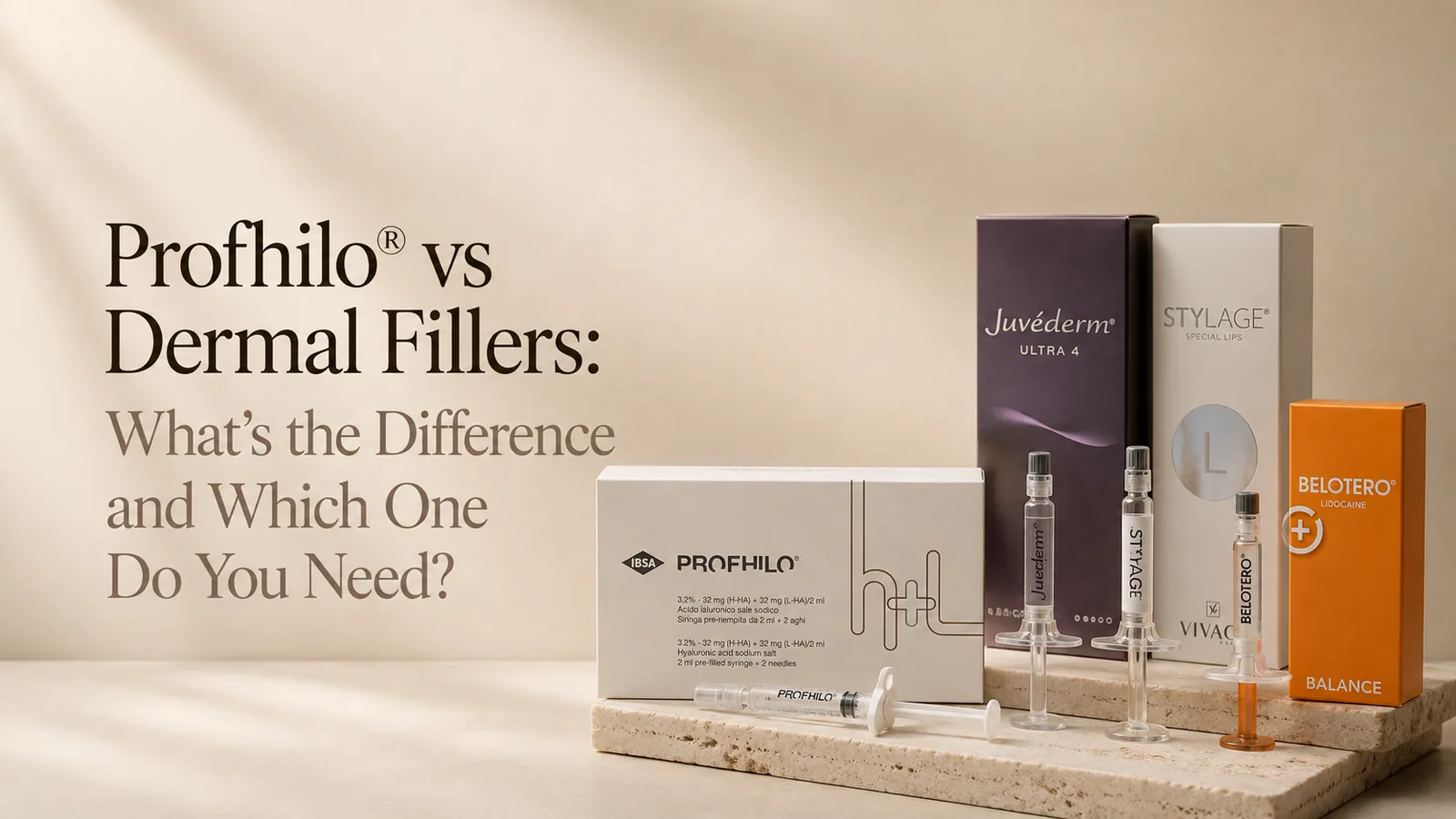
If you are considering injectable treatments in Dubai, you have probably come across both Profhilo® and dermal fillers. They are often discussed together because both involve hyaluronic acid and both are injectable treatments. This similarity, however, is also the reason they are so frequently confused.
Profhilo® and dermal fillers are designed to solve different problems.
Profhilo® is primarily a skin-quality treatment. It is used when the concern is dehydration, reduced elasticity, fine crepey texture or early deterioration in skin firmness.
Dermal fillers, on the other hand, are primarily used when the face requires volume restoration, structural support or contour correction.
In simple terms:
Profhilo® works with the quality of the skin. Dermal fillers work with facial volume and structure.
Understanding this difference matters because a patient who says, “My face looks tired,” does not necessarily need filler. The tired appearance may come from dehydration, pigmentation, volume loss, under-eye hollowing, skin laxity or several of these factors at the same time.
The product should therefore never be the starting point.
The starting point should be understanding what has actually changed in the face.
Why Profhilo® Is Not Simply a “Soft Filler”
One of the most common misconceptions about Profhilo® is that it is simply a very light or natural type of dermal filler.
It isn't.
Profhilo® contains stabilised hyaluronic acid, but it is designed as an injectable skin bio-remodelling treatment rather than a traditional volumising filler.
It is injected at selected anatomical points and distributes within the tissue. The objective is not to build cheekbones, increase lip volume or create a sharper jawline.
Instead, Profhilo® is used to support hydration, elasticity, firmness and overall skin quality.
This makes it particularly interesting for a patient whose facial proportions are already balanced but whose skin has started to feel drier, thinner, less elastic or more crepey.
For example, imagine a patient in her thirties who looks in the mirror and feels that her skin no longer has the same freshness it had several years ago. She does not have significant cheek volume loss. Her chin and jawline are balanced. She does not want to change her facial features.
What she notices is the skin itself.
In this situation, adding structural volume with filler may solve a problem that does not actually exist.
A skin-quality treatment may make considerably more sense.
When Dermal Fillers Make More Sense
Now imagine a different patient.
Her skin is well hydrated, but with age she has developed flattening through the mid-face and visible loss of cheek support. Perhaps the temples have become more hollow or the relationship between the chin, lips and profile has changed.
Hydrating the skin will not replace missing structural volume.
This is where hyaluronic acid dermal fillers may be considered.
Dermal fillers are designed with different physical characteristics depending on where and why they are being used. They may be selected to restore cheek or temple volume, improve chin projection, support the jawline, enhance the lips or soften selected folds.
At Pearl Skin Polyclinic, we work with established hyaluronic acid filler ranges including JUVÉDERM®, STYLAGE® and BELOTERO®, selecting the product according to the anatomy and treatment objective.
The important point is that good filler treatment is not simply about adding millilitres.
It is about understanding where support has been lost and whether replacing it will actually improve facial balance.
Sometimes a very small correction in the right place is more effective than treating several areas.
They Both Contain Hyaluronic Acid — So Why Are They So Different?
This is probably the most confusing part for patients.
Hyaluronic acid is not one universal injectable substance that behaves identically in every product.
Different HA formulations can have very different structures, concentrations, rheological properties and behaviour within the tissues.
Traditional dermal fillers are designed to provide different degrees of support, projection, contour or volume.
Profhilo® is formulated and used differently. Its role is centred on skin bio-remodelling and hydration rather than structural facial correction.
So choosing between Profhilo® and filler based only on the words “hyaluronic acid” does not tell us enough.
The formulation and clinical purpose matter.
“I Don't Want Filler. I Just Want to Look Fresher.”
We hear versions of this sentence frequently.
And it highlights another misconception in aesthetic medicine: that “natural” means avoiding fillers altogether.
It doesn't.
Natural-looking treatment means using the right treatment in the right amount for the right problem.
If a patient has true volume loss, carefully planned filler can restore that volume without making the face look larger or obviously injected.
If the patient's volume is already appropriate and the real issue is dehydrated, crepey skin, adding filler may be unnecessary.
Profhilo® may then be a more logical option.
The reverse is also true. A patient with significant structural volume loss will not restore her cheek support simply by repeatedly treating the quality of the skin.
Skin quality and facial structure are connected, but they are not the same thing.
What About Fine Lines?
Fine lines are another area where patients often choose a treatment based on the appearance of the line rather than its cause.
A fine line caused partly by dehydration and declining elasticity may improve when skin quality improves.
A deeper fold caused by volume loss requires a different approach.
And a line created predominantly by repeated muscle contraction — such as many forehead or frown lines — may be better addressed with botulinum toxin.
This is why simply saying “I want to treat my wrinkles” does not tell us enough to select a procedure.
We need to understand why the wrinkle is there.
And What About Skin Laxity?
The same principle applies to laxity.
Profhilo® may be considered when there are early changes in skin firmness, elasticity and fine crepey texture.
But significant tissue descent is not simply a hydration problem.
Facial ageing occurs at several levels: skin, fat compartments, ligaments, muscle and bone all change over time.
In some patients, treatments such as Morpheus8 RF microneedling, collagen biostimulators or another tissue-remodelling strategy may be more appropriate.
Using large amounts of filler to compensate for significant laxity can add unnecessary volume without addressing the primary problem.
Likewise, expecting Profhilo® to produce a surgical lifting effect would be unrealistic.
Can Profhilo® and Dermal Fillers Be Used Together?
Yes — because a patient can have more than one ageing process at the same time.
Someone may have dehydrated, less elastic skin and genuine mid-face volume loss.
In this situation, Profhilo® and dermal fillers are not competing treatments.
They have different jobs.
Profhilo® can address skin quality, while filler can address structural volume.
The treatments do not necessarily need to be performed during the same appointment. The order, timing and amount should be determined according to the patient's anatomy and priorities.
This is often where aesthetic treatment becomes more sophisticated: rather than asking one product to solve everything, we use different treatments for different anatomical problems.
A Simple Way to Understand the Difference
Think about what you see when you look in the mirror.
If your face still has good proportions and volume but the skin feels dehydrated, less elastic, slightly crepey or generally less fresh, Profhilo® may be worth discussing with your doctor.
If you notice flattening of the cheeks, temple hollowing, loss of chin or jawline support, or another genuine volume deficit, dermal filler may be more relevant.
If the main concern is significant laxity, pigmentation, vascular redness, acne scarring or dynamic wrinkles, the answer may be neither Profhilo® nor filler.
And that is an important part of a good consultation.
Sometimes the correct decision is not choosing between two treatments. It is recognising that the patient needs something completely different.
What If I Want a Natural Result?
“Natural” does not mean avoiding filler.
And it does not automatically mean choosing Profhilo®.
A natural result comes from selecting the correct treatment for the correct anatomical problem.
If volume is missing, carefully selected filler can restore it without creating an overfilled appearance.
If facial structure is already balanced but skin quality has deteriorated, adding filler may be unnecessary and Profhilo® or another skin-quality treatment may be more appropriate.
Natural-looking aesthetic medicine is less about the product and more about correct diagnosis, proportion and restraint.
Profhilo® vs Fillers: Which One Do You Need?
A simple way to think about it:
If your main concerns are dehydration, fine crepey texture, reduced elasticity, reduced firmness or dull-looking skin, a skin-quality approach such as Profhilo® may be considered.
If you have true facial volume loss, flattened cheeks, temple hollowing, reduced chin projection, loss of facial contour or selected deeper folds, dermal fillers may be more appropriate.
And if your primary concern is dynamic wrinkles, significant skin laxity, pigmentation, vascular redness or acne scarring, you may need neither.
A different treatment may be more appropriate.
The Most Important Question: What Is Causing the Change?
Two patients can both say:
“My face looks tired.”
But one may have dehydrated, crepey skin.
Another may have mid-face volume loss.
Another may have pigmentation.
Another may have under-eye hollowing.
And another may simply have strong dynamic lines.
Giving all five patients the same injectable would not be personalised treatment.
At Pearl Skin Polyclinic, we assess skin quality, hydration, facial volume, bone structure, tissue laxity, muscle activity, pigmentation, vascularity and facial proportions before recommending a treatment.
Profhilo® vs Dermal Fillers in Dubai: The Bottom Line
Profhilo® and dermal fillers are not competitors.
They solve different problems.
Profhilo® → Hydration • Elasticity • Firmness • Skin Quality
Dermal Fillers → Volume • Structure • Projection • Facial Contour
For some patients, Profhilo® is appropriate.
For others, filler provides the correction that is actually needed.
Some patients may benefit from both as part of a staged treatment plan.
And sometimes the correct recommendation is neither.
At Pearl Skin Polyclinic in Dubai, the treatment decision begins with facial and skin assessment rather than choosing a product first.
The best injectable is not the most popular one. It is the one that matches the anatomical and biological problem we are trying to treat.